
My Digest for Linen-Backing Posters: Part III - Recipes
Updated: Jul 23

I thought I would do a quick post to document the solution I use for cleaning and deacidifying.
Wheat Starch Paste
I will start with the easy one, which is the Wheat Starch Paste which is as simple as redirecting you to the Talas site for the recipe, but I do add additional Calcium Carbonate to this (10:1 ratio), so if I am making enough for a one-sheet poster, I will do:
100ml of Wheat Starch (TalasOnline)
10ml of Calcium Carbonate (Amazon)
550ml of Distilled Water
It should generally be the consistency of a glue and runny while hot. Once it cools and goes into the fridge, it will firm up. The consistency while cooking isn't too critical though as you will reduce it to get your final consistency after it cools and you strain it through a cheese cloth or do what I do and just use an immersion blender...the goal ultimately is to get the consistency you want and have no lumps.
The Calcium Carbonate provide a couple benefits including: 1) it acts as an acid buffer, 2) prevents mold and insect growth, and 3) improves texture and reduces shrinkage. Obviously #1 and #2 are the biggest benefits.
There is another good recipe which uses flour (just change out for wheat starch) which I find helpful for the mixing process: https://myhandboundbooks.blogspot.com/2008/02/making-paste.html
Cleaning / Deacidify Solution
For the deacidify solution, many do separate solutions for cleaning and deacidify, but I take a simpler route and just combine these steps into a single solution. I found this general recipe and techniques for use at the Liberty Hill Comics primarily - they have a number of YouTube video regarding this among many other techniques more specifically applied to comic book conservation/restoration. Theirs is based on science and what I like about their posts, is that they are detailed and specific, which is often lacking on the various poster restoration forums.
What you will need:
Calcium Hydroxide Ca[OH] (Amazon)
Triton X-100 (Amazon)
Distilled Water
Methyl Cellulose (optional) (TalasOnline, or get the Lineco MC off Amazon)
Coffee Filter and a Funnel
(2) 1 liter Bottle / Jar (plastic or glass are fine)
Some type of a measuring scale to measure Ca [OH]
Measuring beakers to measure 150ml and 450ml of liquids
Magnetic stirrer or stirring stick (shaking is OK too)
A general use syringe to get 10 or so drops of X-100, approximating is fine.
I think I got all the ingredients above off Amazon, but TalasOnline.com and other sources provide them as well.
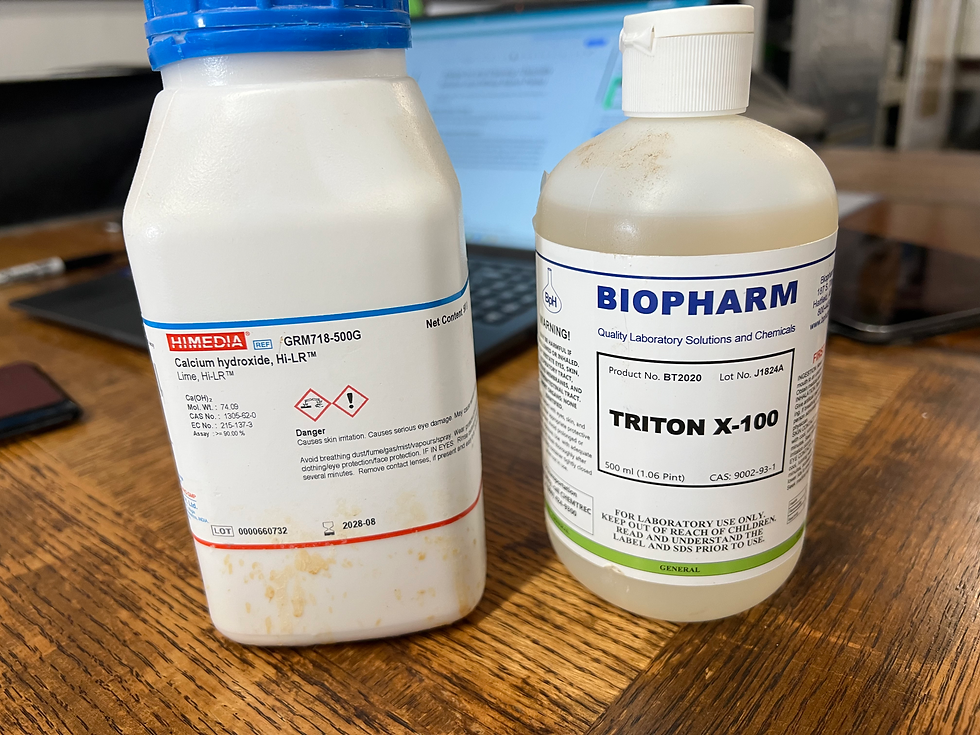
Saturated Calcium Hydroxide Ca[OH] Solution
The first thing you will need to do is to make the Saturated Ca[OH] solution. I make this solution 1 liter at a time. This is a pretty simple and standard method which is to pour 1 liter of distilled water into a glass beaker or bottle. I tend to use the magnetic stirrer since it is fun to watch, but here is the simple breakdown:
Step-by-Step Instructions (with the help of Gemini AI)
Add the Powder: Place about 1 to 2 teaspoons of calcium hydroxide into your container. You don’t need much, as only about 1.5 grams will dissolve in a liter of water at room temperature.
Add Water: Fill the container with about 500ml of distilled water.
Agitate: Close the lid tightly and shake the container vigorously for 1–2 minutes. This ensures maximum contact between the water and the powder. Or pour into the beaker and use the magnetic stirrer.
Let it Settle: Set the jar down and leave it undisturbed for at least 24 hours. You will see the excess, undissolved powder settle at the bottom, leaving a clear liquid on top.
Filter: Carefully pour the clear liquid through a coffee filter into a new, clean container. This clear liquid is your saturated solution.
I actually mix this by the Liter and use 1 liter of distilled water with 1.5 gm of Calcium Hydroxide Ca[OH]. If you use too much of the Calcium Hydroxide, net effect is nothing as any excess will fall to the bottom and its just a small amount of waste. If you don't see any excess falling to the bottom, then you should add more to ensure full saturation. I let it sit for 24-48 hours for any unfiltered particles to go to the bottom, it should appear like normal clear water when ready.
I'm not positive on storage, but I will just put this on a shelf for a few weeks and use as needed, but normally I will just make this a few days before I need it and any unused just get disposed of...but if you plan to do ongoing work, you can just store it on a shelf and use as needed. If it starts to look cloudy, discard and mix a new batch.
This Saturated Calcium Hydroxide Ca[OH] will be used as the base for the Cleaning / Deacidify solution.
Cleaning / Deacidify Solution
The basic recipe for this solution is as follows:
150 ml Saturated Calcium Hydroxide Ca[OH] as mixed above
450 ml Distilled Water (do NOT use tap water, too many impurities)
5-6 drops of Triton X-100 (approximately 0.1%)
up to 10 drops or so depending on strength needed, best to start lighter...I think I got confused in research with 10 drops, but that was per full liter, so i usually just go with the lower amount unless I need more cleaning power. If you see foaming, its too much!
5 ml Methyl Cellulose [optional]
What is Triton X-100? (summary by Gemini AI)
Triton X-100 is a high-performance, non-ionic surfactant that acts as a "scientific-grade soap" for delicate conservation and laboratory work. Unlike household detergents, it carries no electrical charge, making it exceptionally gentle on sensitive materials like vintage paper fibers and proteins. It works by breaking the surface tension of water—essentially making the water "wetter"—which allows cleaning solutions to penetrate deep into microscopic crevices to emulsify oils and lift stubborn grime. In restoration, it is the primary tool used to bridge the gap between water and oily pollutants, allowing conservators to dissolve deep-seated stains and "tide lines" without chemically attacking the underlying artwork. Note that 0.1% to 0.2% is considered a mild solution and you can safely go to 0.5% for heavier stains, but beyond that...do your research, after 1%, its effectively will degrade and rinsing will be more challenging.
Alternatively you can use Orvus which is probably more popular in the poster restoration community. You can get this an most other chemicals needed from TalasOnline.com . If you do use Orvus, you will need to adjust the recipe and use as they are applied differently.
What function does the Methyl Cellulose (MC) perform? (summary by Gemini AI)
Adding methyl cellulose to your cleaning solution acts like a "thickener" that turns a runny liquid into a controllable gel. In layman's terms, it gives the water and soap "grip" so they stay exactly where you put them instead of soaking instantly into the paper or spreading out and making a bigger mess. It holds the moisture in place long enough for the soap to grab the dirt, and then it acts like a microscopic sponge to keep that dirt suspended so it can be pulled away cleanly without sinking back into the fibers. This is more beneficial when using a suction table application and I normally do not use it for standard wet batch cleaning, but another biproduct of the methyl cellulose is it can have a mechanical strengthening effect on the paper.
I am still experimenting with using the MC, but for now, I will primarily use it when I have a delicate paper that needs some re-enforcing / mechanical strengthening of the paper in a wet wash application.
Mixing the Solution
Combine all the ingredients listed in a 1 liter bottle. The 10 drops of Triton X-100 can be adjusted depending on your usage, but start with a lower percent and increase as needed based on testing and prior results. An extra drop or two off the target wont make any dramatic difference.
I make the cleaning solution a day or so before or the day of usage. If I do have extra and store it, I will typically refrigerate it and let it get to room temperature before used again.
Note that using the cleaning / deacidify solution requires you to do multiple rinses with distilled water alone after you have cleaned to remove all of the detergent X-100. If you fail todo this, the result can ultimately be more damaging in the long term for the item being worked on.
In Summary
I have found nothing that indicates that there is any benefit to using separate solutions for deacidifying and cleaning, so I just combine them.
I do need to do some more formal testing to check the pH levels of before and after to ensure the effectiveness, and that will primarily drive the soak duration when applying. I generally will wet the paper / poster it is being applied to between 2 sheets of Mylar and let that sit for 5 or 10 minutes, then transition to multiple rinses of distilled water. Since having a full tray fill with so much solution will take a lot of solution. I have several sprayers that I use to aid in this effort and a big tray I made that allow me to do this cleaning inside with minimal cleanup.
I should probably do a blog post on the 3' x 4' cleaning tray I made and also one for the suction table I am making...more on that as time permits.
Author's Note: A portion of this content was authored with the assistance of AI, mostly for wordsmithing my original technical notes.
Disclaimer: Any links provided are direct links. SecondMoonshot is not an affiliate for any manufacturer, product, or service referenced. We independently purchase and use the products and services mentioned.


Thank you!!! Appreciate your help! Cheers!
These 3 parts you have written so far are so informative. I do hope you continue to make more of them. I am interested in what interleaving/ barrier paper you use and why. Also as an artist, I would love to see your work fixing holes, rips, tears and ending with touching up the art.